
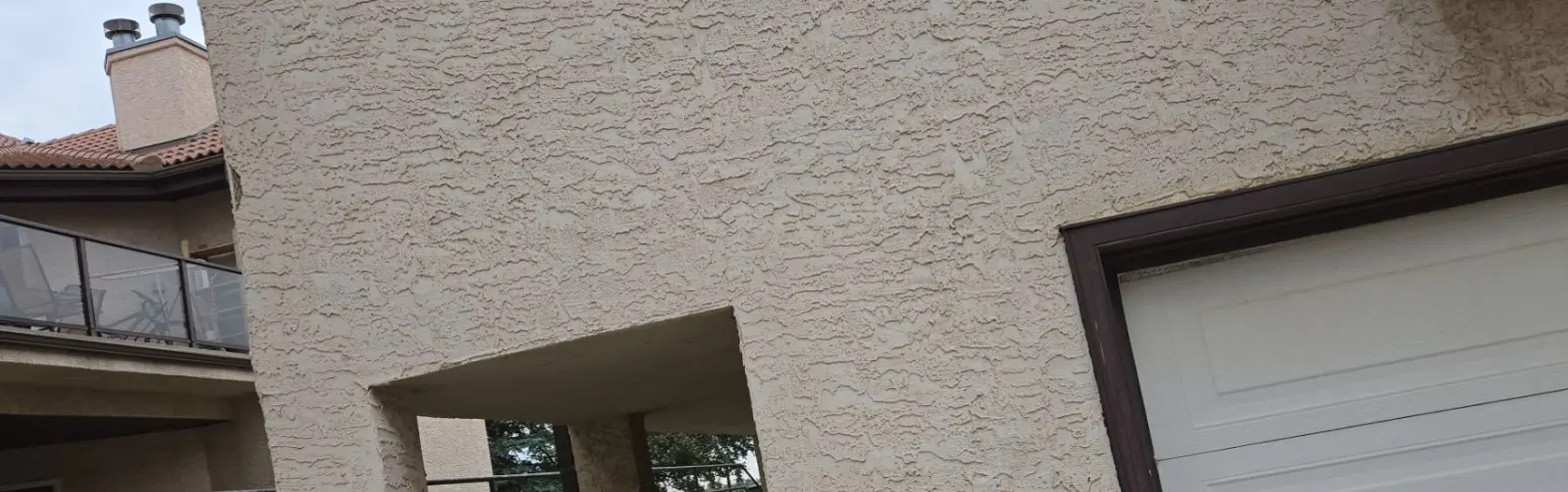
Why Woodpeckers Target EIFS, Not Hard-Coat Stucco
Traditional three-coat stucco is a portland cement-based shell roughly 19–22 mm (¾–⅞ inch) thick bonded to metal lath. It is dense and hard, which makes it materially different from foam-backed EIFS.
EIFS is structurally different. It consists of an expanded polystyrene (EPS) foam board — typically 25–75 mm thick — over which a base coat, fibreglass mesh, and synthetic finish coat are applied. Its softer foam-backed construction is more vulnerable to physical damage than a dense cement shell.
Three behaviours drive the damage:
Territorial drumming. Male woodpeckers drum on exterior surfaces in spring to establish territory and attract mates. The bird may not want insects at all — the drumming is communication.
Foraging. If carpenter ants, paper wasps, or other insects have established a nest behind the EIFS — in the foam itself or in the sheathing behind it — woodpeckers may excavate to reach them. These holes are larger, often conical, and located on the part of the wall that conceals the nest.
Nesting. Some species, particularly the Northern Flicker common in Calgary, will excavate a cavity to nest in. These are large openings, typically 50 mm or wider, usually at a height that suits a nest chamber.
Alberta Species Most Likely to Cause Damage
The bird species most commonly responsible for stucco damage on Calgary homes are the Northern Flicker, Downy Woodpecker, and Hairy Woodpecker — all present in Calgary’s urban and suburban areas and all migratory species protected under the federal Migratory Birds Convention Act, 1994 (Canada). It is illegal to harm these birds, damage their active nests, or disturb eggs or young.
That legal boundary is practical as well as legal: trapping, poisoning, or shooting are not available options. Effective management focuses on deterrence and physical barriers, which also happen to be more reliably long-term because they address why the bird chose the wall in the first place.
What Woodpecker Damage Does to the Wall Assembly
A woodpecker hole in EIFS is more than cosmetic. The opening breaches the finish coat and base coat and exposes raw foam. Water entering through unrepaired holes:
- saturates the EPS foam, which does not drain and holds moisture against the sheathing
- enters the wall cavity and reaches the building paper, sheathing, framing, or insulation behind it
- freezes in Calgary winters, and each freeze-thaw cycle expands the cavity
Moisture damage behind an EIFS wall is not visible from the outside until rot, mould, or interior water stains appear. By that point the repair scope has grown well beyond patching the holes.
Unrepaired holes allow moisture to enter the wall assembly continuously; the longer they remain open through Calgary winters, the greater the eventual repair scope is likely to be.
Deterrents That Work and Ones That Do Not
No deterrent is fully permanent once a bird is committed to a location, but several reduce or eliminate the problem when applied correctly.
Compatible repair materials. Persistent woodpecker damage to EIFS requires a repair approach and finish materials compatible with the existing system. The appropriate scope depends on the condition of the finish, base coat, foam, and substrate.
Visual deterrents. Metallic tape, reflective pinwheels, and holographic streamers create movement and light that startles birds. These work best when installed immediately after a bird begins drumming — before a habit is established — and when placed near the damage site, not on the other side of the house. Their effectiveness typically decreases after a few weeks once the bird habituates.
Physical barriers. Hardware cloth (galvanized metal mesh) or bird netting fastened over the affected area blocks access. It must be held away from the wall surface or the bird will drill through it. Properly installed, mesh is more reliable than visual deterrents but less tidy. It is also not a repair — the damage underneath still needs to be addressed.
Foam backer and spray foam patches are not repairs. Filling a hole with expanding spray foam and painting over it seals moisture into the cavity and does not restore the system’s structural or moisture-management integrity. The hole reappears at the same location because the foam surface is unchanged, the bird returns, and the assembly behind it is now wetter than before.
Inspecting for Damage Before and After Winter
Spring, when snow clears and before nesting season begins in earnest, is the right time to walk the perimeter of any Calgary home with EIFS and look for:
- holes or depressions, even small ones that have been filled informally
- staining below holes (organic growth or mineral deposits indicating water tracking)
- soft, spongy, or slightly raised areas that suggest delamination behind the surface
- gaps at window or door trims that could have been entry points for both birds and water
Repair timing depends on the product and system manufacturer’s application and curing requirements. Cold or marginal conditions can limit or complicate the work, and protected or heated conditions may sometimes be required.
When to Call for an Assessment
If there are multiple holes, holes that have been informally filled before, soft areas around holes, signs of staining, or moisture damage inside the home near affected walls, the damage to assess is not just the holes themselves but the condition of the assembly behind them. Martini Stone Masonry assesses EIFS woodpecker damage, identifies whether the underlying assembly has been compromised, and matches the repair system to the wall.
See Stucco Repair in Calgary for the EIFS repair process and compatible system-specific repair options.
Request a Stucco Assessment Call 587-227-9122
Sources: Woodpecker behaviour and species identification: Environment and Climate Change Canada wildlife information. Legal protection: Migratory Birds Convention Act, 1994, S.C. 1994, c. 22. EIFS system construction: EIFS Industry Members Association (EIMA) technical documentation.