
Most people meet the word in one of two places: an inspection report that says the parging is “deteriorated,” or a quote that offers to re-parge a foundation. Both make more sense once you know what the coat is for, what it is made of, and — the part that is usually missing — where its limits are.
What a Parge Coat Is
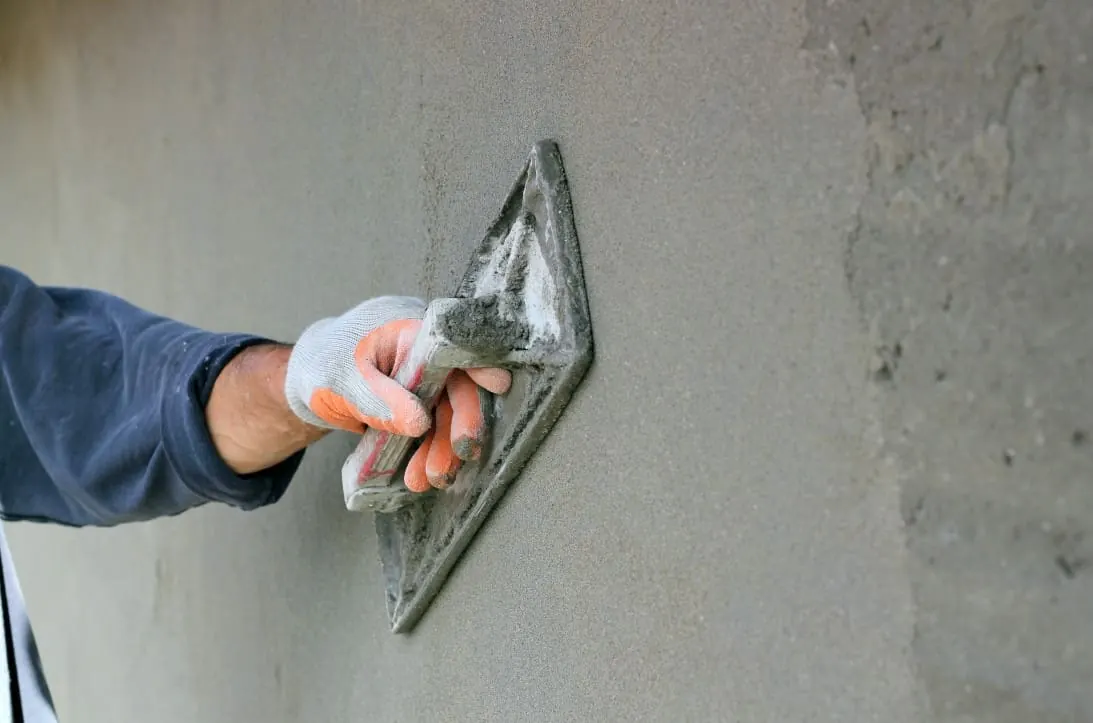
A parge coat is the layer itself: mortar, worked onto the wall with a trowel and finished smooth, floated or textured. A wall that has received one is described as parged.
The material is ordinary cementitious mortar — cement, fine aggregate and water, often with a bonding additive or a polymer modifier to improve adhesion and flexibility. “Parging cement” on a product label means a pre-blended mortar sold for this specific job; it is not a distinct chemistry from other cement-based mortars, and no brand of it changes what the coat can do.
Thickness is the defining feature. A parge coat is worked on in thin lifts — thin enough that it takes its shape and much of its strength from the wall underneath. That single fact explains most of what follows: a thin bonded coat can only be as sound as the bond it achieves and the substrate beneath it.
Where Parging Is Applied
Parging is most commonly applied directly to sound concrete or masonry, without the lath and framing that a cladding system requires behind it. That is the usual case, not a universal rule: depending on the substrate, the condition being repaired and the product system specified, reinforcement such as mesh or lath is sometimes included. It is a project-specific decision made on the wall, not a standard part of every parge coat. Three substrates account for nearly all of the work.
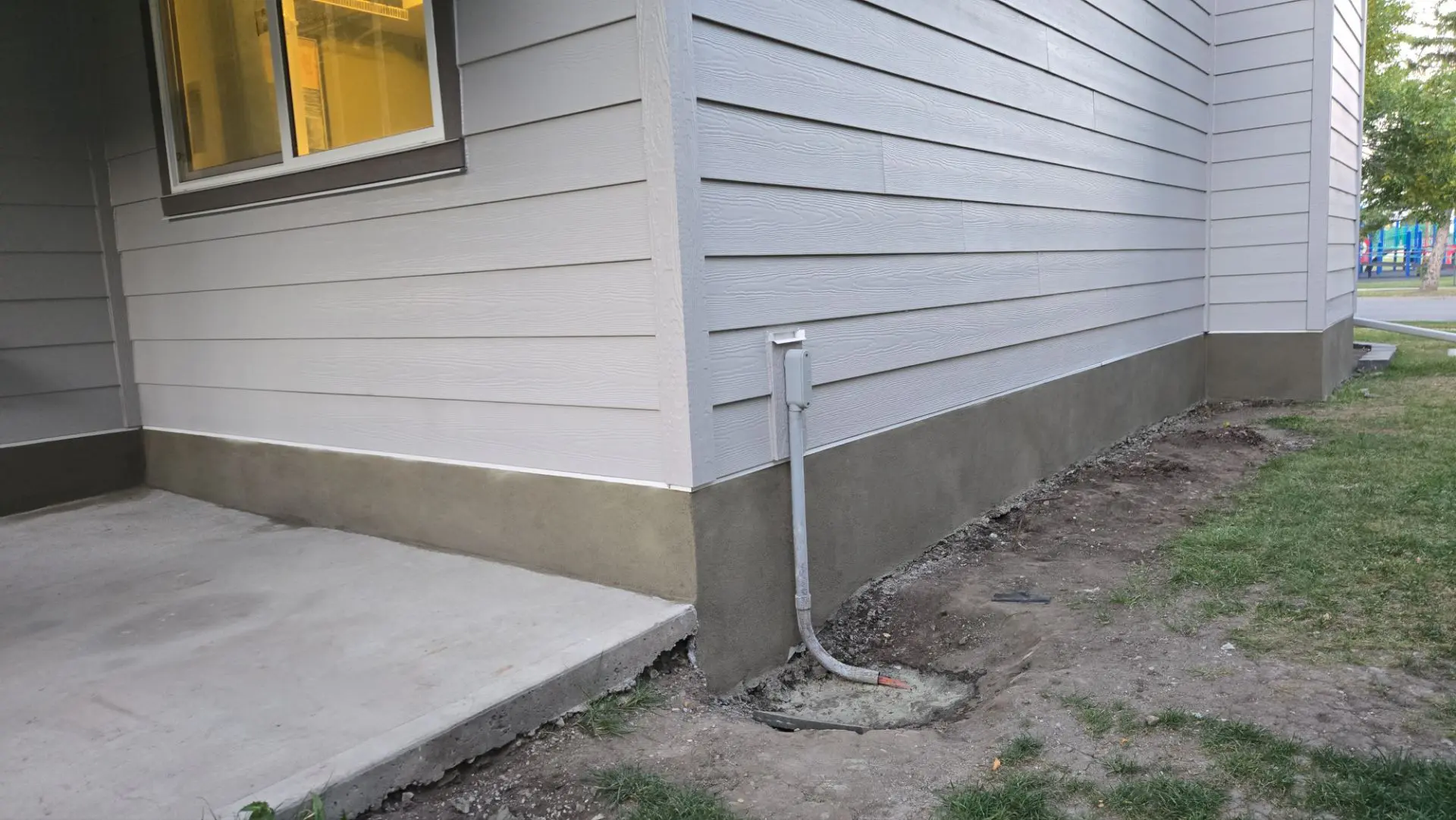
Poured concrete. Formed concrete foundation walls come out of the forms with form lines, tie holes, honeycombing and colour variation. A parge coat closes those irregularities and presents one flat plane. This is the most common residential use — the exposed strip of foundation between grade and siding.
Concrete block. Block walls have an open joint pattern and a porous unit face. A parge coat unifies them into a single surface. On the below-grade portion of a block wall, a parge coat is often applied as the base for a damp-proofing coating rather than as the finish — the coat gives the membrane or damp-proof material a continuous surface to adhere to. It is worth being precise about this: in that assembly the parging is the substrate for the waterproofing, not the waterproofing.
Brick. Parging over brick is done to change the appearance of a wall, to cover previous alterations or mismatched repairs, or to finish a masonry surface that was never meant to be seen. It is a legitimate application, but brick is a more demanding substrate than concrete: brick and mortar joints absorb moisture at different rates, and a coat applied over brick that is damp, salt-laden or spalling will fail at those weak points first. Parging over brick to hide a moisture problem hides the evidence, not the moisture.
What Parging Is Meant to Do
The honest list is short:
- give an uneven concrete or masonry surface a uniform, finished appearance
- close surface porosity, form-tie holes and minor surface defects
- act as a sacrificial weathering surface, so ordinary exposure wears the coat rather than the structural face behind it
- on block, provide a continuous base for a damp-proofing or coating system applied over it
That is the whole job. Everything else attributed to parging belongs to some other part of the building.
What Parging Does Not Do
Parging is not a waterproofing system. A thin cementitious coat bonded to the outside of a wall does not resist hydrostatic pressure, does not bridge a moving crack, and is not a membrane. Water entering a basement is addressed by grading that moves water away from the wall, by drainage and weeping tile, and by a damp-proofing or waterproofing membrane — not by the finish coat on the visible part of the foundation.
Parging is not a structural repair. Covering a crack changes what you can see, not what the wall is doing. A crack that is moving will reappear through a new coat, usually in the same line, because the coat is thinner and weaker than the wall it is stuck to.
Parging is not a vapour barrier or an insulation layer. It does not make a wall airtight, and it contributes nothing to the wall’s thermal performance.
Parging does not fix its own substrate. New material applied over unsound old material inherits that material’s failure. Coating over a defect changes what you can see without correcting what is underneath, and it is one of the most common reasons a parge coat fails early. It is a preparation question before it is a product question.
Parging vs. Stucco
Both are cement-based coats, which is why the words get swapped, but they are different things.
Stucco is a cladding system. It is built up in multiple coats over lath and a weather-resistive barrier on a framed or sheathed wall — or, in EIFS assemblies, over insulation board — and it is designed and detailed as the wall’s exterior finish, with its own drainage plane, control joints and trim.
Parging is a bonded mortar finish. It is a relatively thin mortar coat applied directly to masonry or concrete, in one or more coats depending on the substrate and the system specified. There is no drainage plane behind it and no framed assembly — it is a finish worked onto a wall that already exists.
The practical consequence: stucco is specified as part of a wall assembly, while parging is a surface treatment for a wall that already exists. A stucco failure is often an assembly failure. A parging failure usually points at the bond and what sits behind it — but rarely at one cause alone. The factors that show up, often in combination:
- poor bond between the coat and the wall
- an unsound substrate that was coated rather than corrected
- moisture exposure, including splash-back, snow load against the wall and poor drainage
- insufficient surface preparation before the coat went on
- application conditions — temperature, wind and direct sun during the work
- curing that was cut short or left unprotected
- material or system unsuited to the substrate it was applied over
Which of these dominates is a question answered at the wall, not from a photograph.
Parging vs. Concrete Coatings and Render
Render is the UK and European term. It covers mortar-based exterior finishes applied to masonry, and it overlaps with what is called parging in Canada, and in casual use the two words point at the same picture — but the overlap is not exact. Render systems vary in thickness, in how many coats they carry, in the substrates they are specified over and in what they are expected to do, from a thin decorative skim to a much heavier multi-coat system. Read “render” as a related family of finishes rather than a straight synonym.
Concrete coatings are a different category. Acrylic, elastomeric and cementitious paint products form a film on the surface, measured in mils rather than millimetres. They colour and seal a surface; they do not build out irregularities or level a wall. A coating over an uneven foundation still reads as uneven.
How Is Parging Applied?
This is what the work involves when it is done properly. It is an overview of the sequence a professional follows, not a set of instructions to work from — the specifics change with the wall in front of you.
Inspect the wall and the substrate. Before anything is mixed, the existing surface is read: what is bonded, what is hollow, where moisture is arriving, whether cracking looks like surface movement or something structural. This step decides the scope of everything after it.
Remove loose and unsound material. Anything that has lost its grip comes off, back to a stable edge. This is the step most often shortened, and shortening it is what puts a new coat on a failing one.
Clean and prepare the surface. Dust, efflorescence, residues and contaminants prevent adhesion. The wall is cleaned and brought to the surface condition the chosen product needs — which for many systems means a dampened, absorbent substrate rather than a dry or a saturated one.
Address cracks and defects appropriately. Surface defects are treated on their own terms. Cracking that suggests movement, or a defect that runs deeper than the finish, is a separate question that a new coat does not answer.
Establish the bond the system requires. Depending on the substrate and the product, this can mean a bonding agent, a scratch coat, a specific surface profile, or in some conditions mesh or lath reinforcement. It is specified for the wall, not applied by default.
Apply the coat, or coats, the system calls for. Some products are designed for a single pass; others are built up in more than one, with the required set time between them. Coat count follows the substrate and the manufacturer’s system, not a fixed rule.
Finish to the required texture. Smooth, floated or textured, chosen to suit the wall and to match adjacent surfaces where that matters.
Protect and cure the work. Cementitious materials gain strength through curing, not simply drying. Protection from direct sun, wind, rain and — in this climate especially — from freezing before the coat has matured is part of the job, and the requirements come from the product and the conditions on the day.
Preparation, reinforcement, coat count, finish and curing method all vary by substrate and system. Two walls on the same street can need different answers, which is why the inspection at step one carries as much weight as the application itself.
Patching a Parge Coat vs. Recoating a Wall
The deciding property is bond, not appearance.
Where the surrounding coat is still firmly attached and the substrate is sound, damaged sections can be cut back to a solid edge and patched. The repair is local because the failure is local.
Where the coat is hollow across large areas, is lifting in sheets, or has already been patched repeatedly, patching adds new material to a wall that is losing its grip. Removing the unsound coat back to a stable substrate and recoating the wall is the alternative, and the decision turns on how much of the wall still holds.
A practical field test explains most of it: tapping a bonded coat gives a solid sound, and tapping a delaminated one gives a hollow one. Hollow areas will come off regardless of what is applied over them.
Deciding between a patch and a full recoat is a judgement about how much of the wall still holds — and it is worth having someone look at the wall itself before committing to either.
Signs a Parge Coat Is Failing
- hollow sound under light tapping — the coat has separated from the wall, even where nothing is visible yet
- flaking, powdering or spalling, most often on the lowest band of the wall where snow and splash-back sit
- sections lifting or curling away at edges and corners
- cracking, with the distinction that matters: fine, stable surface cracking is a coat problem, while a crack that recurs in the same line after repair, or that continues into the substrate, is a movement question
- efflorescence — white powdery salt deposits left behind by water moving through the assembly and evaporating at the surface
- exposed substrate, where the concrete or block face is visible through the coat
In a freeze-thaw climate the pattern is specific and seasonal; what repeated freezing and thawing does to a foundation coat covers how it presents through a Calgary winter and spring.
When Deterioration Becomes a Repair Question
Cosmetic surface wear on an otherwise bonded coat is maintenance. It becomes a repair question when any of the following is true:
- the substrate is exposed to weather
- hollow or delaminated areas are widespread rather than isolated
- the same area has been patched more than once
- cracking recurs in the same line after repair
- moisture is showing on the inside of the wall
The last two are the ones worth taking seriously, because they point past the coat. Recurring cracking suggests movement, and interior moisture suggests grading, drainage or a membrane problem — and in both cases recoating the outside face treats the symptom while the cause keeps working.
That is where an assessment earns its keep: someone looking at the substrate, the bond, the grading and the drainage together, before deciding whether a coat is the answer at all. Martini Stone Masonry’s foundation parging and resurfacing work starts at that assessment, and what the work costs is broken down separately by product type and project size.
Frequently Asked Questions
What does parged mean?
It describes a wall that has had a parge coat applied — a thin cement-based mortar coat troweled over concrete or masonry to give it a uniform finished surface.
Does parging waterproof a wall?
No. A parge coat is a finish, not a membrane. It does not resist hydrostatic pressure and does not bridge moving cracks. Keeping water out of a basement is the job of grading, drainage and a damp-proofing or waterproofing membrane. On block walls a parge coat is sometimes applied underneath a damp-proofing product, as the surface that product bonds to — which makes it the substrate for the waterproofing, not the waterproofing itself.
Can parging be applied over brick?
Yes, and it is done to unify or conceal a brick surface. Brick is a less forgiving substrate than concrete, because brick and mortar absorb moisture differently and any salt, dampness or spalling in the brick will show up as a failure in the coat above it.
Is parging the same as stucco?
No. Stucco is a multi-coat cladding system built over lath and a weather-resistive barrier as part of a wall assembly. Parging is a relatively thin mortar finish bonded directly to masonry or concrete — applied in one or more coats depending on the system — with no drainage plane or framed assembly behind it.
What is parging cement?
A pre-blended cement-based mortar sold for this application, sometimes polymer-modified for better adhesion and flexibility. It is a convenience product rather than a distinct material class, and no formulation changes what a thin bonded coat is capable of.
How long does parging last?
There is no single figure that holds across every wall. Service life is governed by the condition of the substrate, the quality of the bond achieved, exposure at the base of the wall, drainage and moisture around the foundation, the standard of application and curing, and the specific product or system used — and a coat applied over unsound material can fail in a season regardless of what the product is rated for.
Treat any published lifespan as a general estimate rather than a prediction for your wall, unless it accounts for those variables. A figure quoted with the substrate, the preparation and the exposure attached to it is worth something; the same figure quoted on its own is not.